

Wedoany.com Report-Mar 24, Smart breeding took center stage at the 2025 Seed Congress and Nanfan Agricultural Silicon Valley Forum, which was held from Thursday to Sunday in Sanya, South China's Hainan Province, as Chinese scientists gathered to engage in discussions on how to better apply AI technology in breeding to enhance yield and improve crop varieties.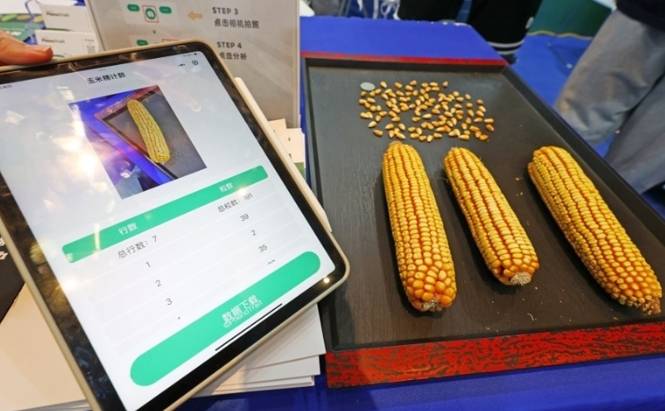
The smart seed counting applet on display at the 2025 Seed Congress and Nanfan Agricultural Silicon Valley Forum held in Sanya, South China's Hainan Province from March 19 to March 23, 2025.
Chen Xiaoya, an academician of the Chinese Academy of Sciences (CAS) and researcher at the CAS Center for Excellence in Molecular Plant Sciences, briefed the latest advances in AI breeding, elaborating on the cutting-edge applications and breakthroughs of AI technology, and showcasing the vast potential of AI-driven breeding to industry practitioners.
Biological breeding has helped researchers identify key points, Chen said.
Chen noted that biological breeding is a complex, multidisciplinary field that requires collaboration among experts from various domains to drive its development effectively. For instance, in gene editing technology, the integration of knowledge from biology, chemistry, computer science and other disciplines is essential to precisely edit crop genes and cultivate new varieties with desirable traits.
CAS academician Qian Qian believed that crops possess thousands of agronomic traits, it is necessary to use computing and algorithms to uncover the relationships between genes and traits, thereby integrating superior traits. Unlike traditional small workshop-style breeding, smart breeding requires an industrial approach to pool vast resources.
CAS academician Li Jiayang also shared insights into the latest advancements and applications of "intelligent breeding," which has garnered significant attention. Li explained the concept of "intelligent variety with intelligent cultivation," which integrates biotechnology, information technology, and AI to develop varieties capable of autonomously responding to environmental and climatic change, according to the report.
According to Li, intelligent varieties can autonomously adapt to environmental changes, dynamically adjust plant architecture at different developmental stages, enhance the utilization efficiency of agricultural resources such as light, fertilizers, and water, increase grain yield, improve taste and nutrition, and reduce reliance on chemical inputs and mitigate losses from natural disasters.
Li noted that leveraging cutting-edge biotechnologies, information technologies, and AI, along with achieving quantitative data collection and intelligent data analysis, can further enhance breeding innovation efficiency.
Meanwhile, AI breeding is moving from theory to reality.
Researchers at China National Seed Group Co, Ltd can obtain information accurately on breeding research, seed production and other details from various bases simply by using a single screen. Through data transmitted by remote sensing, scientists can access real-time analyses of abnormal areas and plant canopy moisture levels at these bases, enabling them to take timely and appropriate measures.
The Yazhouwan National Laboratory, together with the Shanghai Artificial Intelligence Laboratory and other institutions, has launched the first large language model for the seed industry, named "SeedLLM,".
China National Seed Group also unveiled its"Corn Variety Advancement and Precision Positioning Decision System," which rapidly and accurately analyzes the strengths and weaknesses of varieties and precisely identifies optimal planting regions.
Developing a superior crop variety involves screening hundreds or thousands of hybrid combinations, a labor-intensive and time-consuming process. Li Huihui, a deputy director of the National Nanfan Research Institute of the Chinese Academy of Agricultural Sciences, leads a team focused on predicting crop growth and precisely screening potential materials.
The team has developed an AI algorithm, an automated machine learning framework, that integrates environmental data with genomic information for precise genetic analyses and genomic prediction, reducing computation time by 290 times compared with traditional models, and offering an effective tool for intelligent crop breeding.
A seed counting machine produced by Laufer Vision powered by a parameter model helps simplify the process of counting and packaging crop seeds. The device can process six bags of 1,000 tomato seeds per minute, making it ideal for large-scale production.









 京公网安备 11010802046720号