

Wedoany.com Report-Apr 4, The Netherlands’ Board for Plant Varieties has recently granted plant breeders’ rights to a groundbreaking new potato variety developed using KeyGene’s proprietary 2S1® technique. This innovative method combines the skin traits of Pimpernel with Bintje’s inner cell layers, creating a hybrid that retains both parent varieties’ essential properties while introducing new, beneficial traits.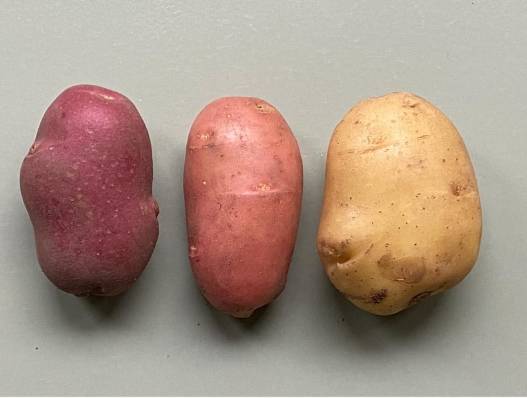
Three potatoes of: Jeroen KG (in the middle) Pimpernel and Bintje
The 2S1® technique, known for its ability to create stable and high-yield potato varieties, allows for the seamless transfer of skin characteristics such as drought tolerance and insect repellence from one variety to another. This combination results in a hybrid potato that not only maintains the unique qualities of both parent varieties but also exhibits these traits on all parts of the plant, including the tubers.
KeyGene scientists have emphasized the stability and reliability of this new variety. After several years of production, the seed potatoes, the parent plants, and the resulting crops all faithfully maintain the unique skin combination inherited from Pimpernel and Bintje. This breakthrough demonstrates a novel approach to harnessing natural genetic variation for breeding purposes, offering a more efficient and sustainable method for developing new potato varieties.
Jeroen Stuurman, a distinguished scientist at KeyGene and lead developer of the 2S1® technology, described the achievement as a “major step in plant breeding.” The technique has the potential to revolutionize the development of new potato varieties, as well as similar crops like fruit trees and berries, by enabling breeders to combine favorable traits from different parent lines more efficiently and cost-effectively.
The granting of plant breeder’s rights by the Netherlands’ Board for Plant Varieties highlights the commercial viability of this new variety. It serves as a “proof-of-concept” for KeyGene’s 2S1® technique, showcasing its potential to unlock new possibilities in sustainable food production by combining beneficial traits from different parent varieties in a streamlined and efficient manner.






 京公网安备 11010802046720号