

Wedoany.com Report-Nov. 25, New Zealand has officially opened Hangar 4 at Auckland Airport, the world's first aircraft maintenance facility constructed primarily from engineered timber. The structure, commissioned five years ago by then-Air New Zealand CEO and now Prime Minister Christopher Luxon, was formally inaugurated by him in September.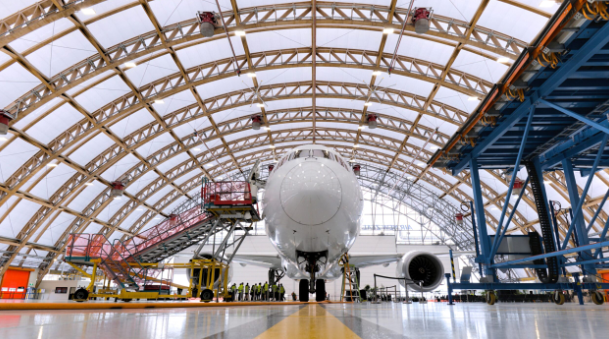
It spans (almost) 100 metres, flexes under the highest seismic loads, and proves once and for all that wood can exceed traditional steel and concrete in aviation construction.
Recognised as the Southern Hemisphere's largest free-spanning timber arch, the hangar covers 10,000 square metres, spans nearly 100 metres, and rises 35 metres high. It can simultaneously accommodate one Boeing 787-9 Dreamliner and two Airbus A320/A321 aircraft.
The facility uses locally sourced cross-laminated timber (CLT) and laminated veneer lumber (LVL) supplied by XLAM and Nelson Pine. Twenty massive arches, each comprising prefabricated 25-metre sections and secured with up to 12,500 screws per truss, were assembled on site and lifted into position using New Zealand's largest crawler crane. In total, the project incorporated over 780 cubic metres of CLT panels and 580 cubic metres of LVL beams.
Designed for one of the world's most active seismic zones, the timber arches can flex up to 300 millimetres during earthquakes, absorbing energy rather than resisting it. An ETFE roof canopy provides abundant natural light and thermal retention, eliminating the need for conventional heating.
Tom Bruce-Jones, owner of XLAM and Chair of the Hyne Group and James Jones and Sons Group, stated: "I am immensely proud of all stakeholders involved with this project. The structure stands as a testament to innovative, creative thinking and exemplifies the versatility of wood as a construction material. By embracing timber as a core material, we are not only delivering architectural excellence but championing sustainable construction practices."
Keith Knox, XLAM's General Manager, highlighted the Design for Manufacture and Assembly (DfMA) approach: "The DfMA approach enabled us to adopt a highly structured, early-manufacture and pre-assembly process to ensure the project met programme constraints both onsite and across the wider supply chain."
Components were prefabricated in Nelson and transported 860 kilometres to Auckland using specialist trailers on 3D-scanned routes. A full-scale prototype section was built beforehand to verify the complex geometry.
The hangar demonstrates advanced seismic engineering combined with low-carbon timber construction, setting a new global benchmark for large-scale sustainable aviation infrastructure while showcasing New Zealand's expertise in engineered wood technology.










 京公网安备 11010802046720号