

Wedoany.com Report-Nov. 10, China has launched its first commercial ammonia-to-hydrogen production and refuelling station in Nanhai District, Guangdong Province, marking a significant advance in hydrogen energy deployment. The facility, developed by Fuda Zijin Hydrogen Energy Technology, has a daily hydrogen output of 1,000 kg and is now fully operational. It represents China’s first large-scale commercial site integrating ammonia decomposition, hydrogen purification, and refuelling in a single closed-loop system, moving beyond demonstration-scale projects to full commercial implementation.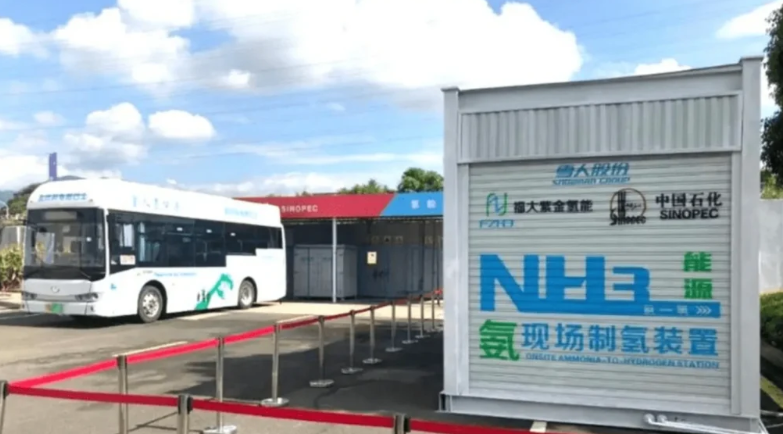
Fuda Zijin’s system employs a low-temperature ammonia decomposition process, operating around 480 °C, achieving a hydrogen conversion rate exceeding 99.5%. Compared with conventional high-pressure hydrogen delivery, the on-site ammonia-to-hydrogen approach can reduce hydrogen production and transport costs by 40–50%. Unlike traditional stations that rely on pre-delivered hydrogen gas, this facility generates hydrogen on demand from liquid ammonia, enabling immediate refuelling. Its capacity is sufficient to serve more than 100 hydrogen-powered heavy-duty trucks in the region.
The ammonia-to-hydrogen system integrates hydrogen generation, separation, purification, pressurisation, and refuelling into a single modular platform. According to Fuda Zijin, this approach “significantly reduces storage and transportation costs, improves safety, and provides a closed-loop zero-carbon ammonia-hydrogen energy solution.” The facility can flexibly adjust production to meet fluctuating hydrogen demand, addressing storage and utilisation challenges faced by many refuelling stations. Fuda Zijin is promoting the technology for applications across road transport, urban rail transit, and marine sectors, providing scalable solutions for zero-carbon energy infrastructure.
The Nanhai District government has positioned the area as a national hydrogen hub, aiming to establish the “Capital of China’s Hydrogen Energy Industry.” The new station complements the region’s growing hydrogen cluster, which includes Huate Gas and the Meijin Hydrogen Industrial Headquarters Base. By integrating efficient hydrogen production with refuelling, the project strengthens Nanhai’s role in supporting fuel-cell trucks and other hydrogen applications in heavy transport.
The ammonia-to-hydrogen facility highlights China’s efforts to diversify hydrogen supply pathways. Ammonia, used as a hydrogen carrier, offers logistical and cost advantages, particularly for long-distance transport and heavy-duty vehicles. While ammonia is not a replacement for green hydrogen, it serves as a complementary solution to support commercial hydrogen deployment while broader infrastructure develops. Challenges such as ammonia toxicity, cracking efficiency, and emissions control remain, but the project demonstrates the feasibility and scalability of on-site ammonia-to-hydrogen systems.
This milestone underscores the potential of ammonia-based hydrogen technology to accelerate the adoption of fuel-cell transport solutions and strengthen zero-carbon energy infrastructure, positioning Nanhai District at the forefront of China’s hydrogen energy development.











 京公网安备 11010802046720号