

Wedoany.com Report-Apr. 21, Cape Horn Engineering, a UK-based marine technology consultant, has achieved highly accurate and efficient results in a blind tidal turbine validation study, part of a benchmarking initiative funded by the UK’s Engineering and Physical Sciences Research Council (EPSRC) and the Supergen Offshore Renewable Energy (ORE) Hub. The study aimed to advance tidal energy technology by reducing modeling uncertainties in turbine design.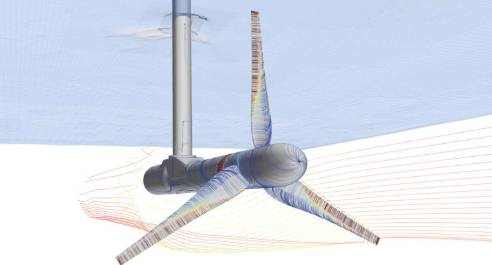
The research utilized experimental data from a 1.6-meter tidal rotor tested at QinetiQ’s Haslar facility under steady flow conditions, with and without added turbulence. The objective was to validate numerical modeling methods for offshore renewable energy and minimize design conservatism. Twelve groups from academia and industry submitted blind computational fluid dynamics (CFD) results, ranging from low-fidelity models to high-fidelity blade-resolved CFD.
Cape Horn Engineering employed Siemens’ STAR-CCM+ code for high-resolution simulations, incorporating full rotor geometry, nacelle, tower, tank walls, and free-surface effects. The firm stated: “The solutions of CHE-BR-uRANS were found to be very effective with a significantly lower cell count compared to other methods, whilst returning some of the most accurate solutions.” Their approach replicated the experimental setup, including rotating blades, tank boundaries, and water surface deformation, achieving high accuracy with simulations running in four to five hours on 32-core systems using an average mesh size of 3.5 million cells.
The results closely aligned with experimental data. In low turbulence conditions, the average differences in power and thrust coefficients were 0.67% and 2.10%, respectively. In elevated turbulence, differences were 2.02% and 2.74%, all within the 95% confidence range of the experimental data. Cape Horn Engineering’s submission included a verification and validation study, reporting numerical uncertainties below 1% for key parameters, ranking among the most accurate and efficient in the benchmark.
Unlike some participants who omitted elements like tank walls or free surfaces, Cape Horn Engineering’s comprehensive modeling approach enhanced reliability. Beyond tidal energy, the firm applies its CFD expertise to wind energy rotors, floating platforms, wave energy structures, service operation vessels, and crew transfer vessels, supporting advancements in renewable energy technologies.










 京公网安备 11010802046720号