

Wedoany.com Report-Aug. 21, China is expected to remain the world’s largest hydropower market through 2030, supported by strong domestic investment and the global expansion of Chinese enterprises, industry experts and executives said. According to a recent report by the International Hydropower Association (IHA), China accounted for over half of all new hydropower capacity worldwide last year. Global hydropower capacity grew by 24.6 GW in 2023, with China contributing 14.4 GW, nearly 60 percent of the total.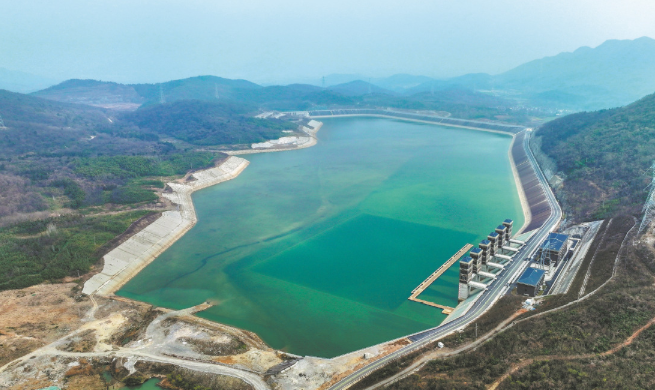
The No 3 unit of the Jurong Pumped-Storage Power Plant in Jurong, Jiangsu province, which was connected to the grid for power generation on March 10.
More than half of China’s new hydropower capacity came from pumped hydro storage, which added 7.75 GW. IHA noted that China currently has over 91 GW of pumped hydro projects under construction and is likely to surpass its 2030 target of 120 GW. With an additional 136 GW planned, the country is on track to accelerate its leadership in this field.
Chinese hydropower companies are also expanding their presence in developing regions, particularly through the Belt and Road Initiative. Lin Boqiang, head of the China Institute for Studies in Energy Policy at Xiamen University, explained: "As many developing nations are seeking reliable and affordable energy sources, hydropower is seen as a potential solution. On the other hand, Chinese State-owned banks and other financial institutions play a crucial role in financing these projects."
China Three Gorges Corporation (CTG) is one of the leading players overseas, with its subsidiary CTG International operating across five continents. Its projects include the Karot Hydropower Station in Pakistan, developed under the China-Pakistan Economic Corridor, which has an installed capacity of 720 MW and generates about 3,200 GWh annually, meeting the power needs of more than 5 million people.
Domestically, China is advancing major projects, including a large-scale hydropower development on the lower reaches of the Yarlung Zangbo River. The project, consisting of five cascade stations, is expected to require about 1.2 trillion yuan ($167.8 billion) in investment. It will serve both local electricity demand in the Xizang autonomous region and external consumption, while also supporting the integration of wind and solar power to create a clean energy base.
China has also established the world’s largest clean energy corridor along the Yangtze River. With six mega hydropower stations totaling 71.7 million kW, the corridor generated a record 295.9 billion kWh last year, saving an estimated 89.24 million metric tons of standard coal and cutting more than 240 million tons of carbon dioxide emissions, according to China Yangtze Power Co Ltd.
Experts highlight that pumped hydro storage plays a vital role in stabilizing the grid as renewable energy grows. Zhang Zongliang, academician at the Chinese Academy of Engineering, said pumped hydro storage acts as "super charging stations," storing power when demand is low and releasing it during peak periods. The China Renewable Energy Engineering Institute reported that 23 new pumped hydro storage projects were approved last year, consolidating China’s leadership for the ninth consecutive year.
By the end of 2024, China’s installed wind and solar power capacity exceeded 1,200 GW, reaching its 2030 target ahead of schedule. State Grid Corp of China has also increased investment, allocating 36.5 billion yuan to pumped hydro projects. With 75 stations in operation or construction, totaling 94 million kW, it is the world’s largest operator of pumped hydro facilities. Decades of technological accumulation have enabled China to establish a complete industrial system for hydropower and pumped storage development, ensuring its continued global leadership in clean energy.











 京公网安备 11010802046720号