

Wedoany.com Report-Aug. 27, JA Solar has launched DesertBlue, a new photovoltaic module series tailored for large-scale ground-mounted projects in desert, Gobi, and arid regions. The introduction event was held in Beijing and attended by engineering institutes, project developers, and certification organizations, including Inner Mongolia Electric Power Survey & Design Institute, ACWA Power, TÜV Rheinland, TÜV SÜD, and CCIC.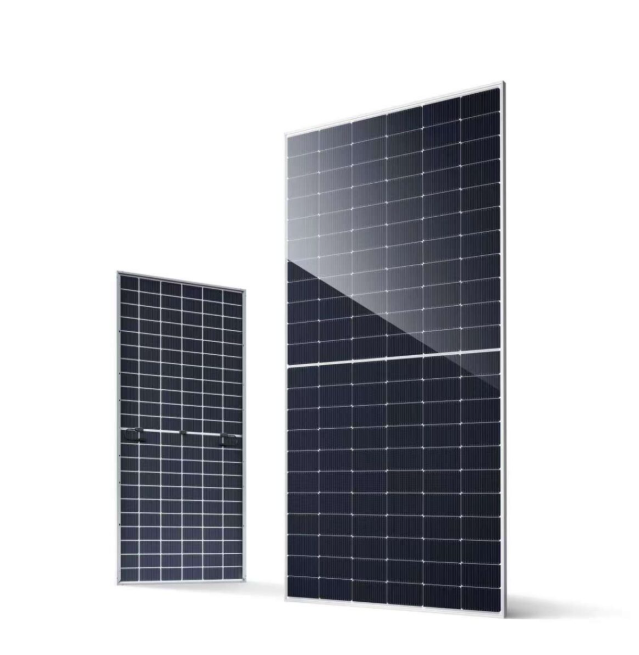
The DesertBlue modules
The DesertBlue modules are designed to address four operational challenges common in sandy environments: fine dust accumulation that reduces light transmittance, coarse-grain abrasion that accelerates film aging, high wind loads that stress module structures, and extreme temperatures that impact output and durability. With a maximum nameplate power of up to 650 W and a peak conversion efficiency of 24%, DesertBlue aims to deliver high performance under harsh conditions.
The product incorporates four performance pillars. The first is dust resistance: a nano-scale self-cleaning coating with dense microstructures and antistatic properties reduces dust adhesion and allows wind to assist in cleaning. This results in light-transmittance loss more than 32% lower than conventional module glass.
The second is durability: enhanced film hardness and abrasion resistance improve reliability by at least 32%, extend service life by three to five years, and reduce power loss by 14% under heavy sand exposure.
The third is structural strength: modules feature a reinforced design with a high-strength steel frame capable of withstanding 6,000 Pa front-side and 4,000 Pa back-side load ratings, which is over 60% higher than standard modules. The conductive frame also reduces the need for grounding materials, lowering related emissions.
The fourth is high-temperature performance: DesertBlue’s temperature coefficient of –0.28%/°C, combined with TOPCon cells’ higher open-circuit voltage, is expected to increase energy yield by 0.5–0.6% at ambient temperatures of 50°C and module operating ranges of 75–85°C. In dusty settings, module temperatures drop by around 5°C, providing approximately 1.5% additional yield.
JA Solar also quantified the economic benefits for users. In construction, cost savings come from reduced grounding needs ($0.0004/W) and lower capital costs for cleaning robots ($0.006/W in China and $0.004/W in the Middle East). In operations, a 100 MW desert plant using manual dry-brush cleaning could cut cleaning frequency in half, saving $34,000 annually and $0.84 million over 25 years. For robotic cleaning, 25-year operational savings were estimated at $0.98 million in northwest China and $0.76 million in the Middle East. At the Mengneng Ulan Buh project, DesertBlue achieved an energy yield 4.49% higher than conventional modules.
The series has been certified by TÜV Rheinland as the first “desert module,” demonstrating resistance to UV, thermal stress, abrasion, sand, and cleaning wear. TÜV SÜD confirmed long-term durability after 11,000 robot-cleaning cycles under dusty conditions, with minimal (<1%) power loss and no structural damage.
Industry experts noted that large-scale desert base construction under China’s “15th Five-Year Plan,” as well as projects in the Middle East and Africa, require modules capable of withstanding frequent cleaning and environmental stress. JA Solar positioned DesertBlue as a dedicated solution for these markets, combining advanced design features with third-party certification.











 京公网安备 11010802046720号