

Wedoany.com Report-Apr. 18, Zelostech, a Chinese autonomous driving startup, is accelerating its global expansion with advanced Level 4 self-driving technology. The company recently completed a Series B fundraising round, securing nearly $300 million to support product development, supply chain establishment, market expansion, urban operational networks, and industry partnerships.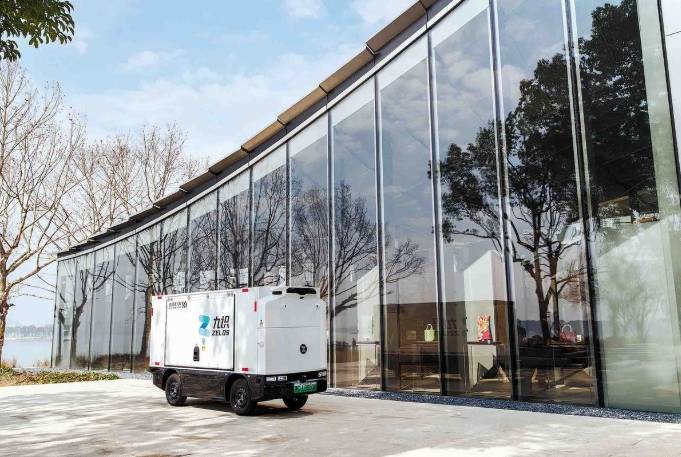
A Zelostech unmanned logistics vehicle is seen at a facility in Suzhou, Jiangsu province.
Co-founder Zhuang Li stated: “We are striving to build an algorithm that can run not just across China but around the world. An algorithm — by deeply understanding and generalizing diverse traffic environments — can learn from Beijing traffic and still handle a rainy day in Singapore, or even a complicated road of Berlin.” This vision drives Zelostech’s efforts to create adaptable autonomous systems.
The company has made significant strides internationally. In early 2024, Zelostech contributed to Singapore’s first driverless logistics standards, addressing a regulatory need, and passed the M1 test to obtain the country’s first unmanned logistics vehicle license. Zhuang noted: “The company has also rolled out its first autonomous delivery vehicle in South Korea, followed by deployments in Japan in November last year and Europe in January this year.”
In April 2025, Zelostech marked 100 days since launching its 2025 L4 urban delivery series. These vehicles feature a streamlined design with solid-state lidar and high-resolution cameras, replacing traditional mechanical lidar. Zhuang explained: “This is the first large-scale rollout of a solid-state lidar solution on an L4 production vehicle.” The design enhances aesthetics and allows adjustable cargo box heights for diverse delivery needs, from e-commerce to industrial transport.
Powered by Zelostech’s Jupiter inference engine and dual-camera 3D perception, the 2025 series achieves decision latencies below 50 milliseconds. The company’s full-stack research in sensor fusion, AI decision-making, and edge computing supports these advancements. Last year, Zelostech’s monthly deployment rate grew by over 45 percent for five consecutive months, with operations now spanning six countries and over 200 regions, a 387 percent year-on-year increase in operating cities.
Zelostech’s vehicles are also serving specialized areas. In Inner Mongolia’s grasslands, a fleet covers daily 100-kilometer routes, reducing rural delivery times and costs by approximately 40 percent. Zhuang said: “These use cases highlight the versatility of a one-algorithm platform.”
With cost-effective solid-state lidar, the 2025 models aim to lower ownership costs, enabling adoption in smaller markets. Zhuang emphasized: “We’re not just selling vehicles. We’re delivering a plug-and-play logistics solution that can be replicated anywhere.” He added: “We believe the era of universal intelligent delivery is within reach. Our mission is to make advanced driving accessible, equitable and profitable for operators everywhere.”
The global autonomous vehicle market, valued at $207.38 billion last year, is projected to grow at a 36.3 percent compound annual growth rate from 2025 to 2034, highlighting Zelostech’s potential to shape the future of efficient, low-carbon logistics.










 京公网安备 11010802046720号