

Wedoany.com Report-Oct. 17, The UK-based classification society Lloyd’s Register (LR) has released new guidance providing the maritime industry with its “first” roadmap for nuclear-powered shipping. The document, titled “Navigating Nuclear Energy in Maritime”, outlines a pathway for the “safe and responsible” use of nuclear technology in commercial shipping and offshore operations, addressing regulatory, operational, technical, and economic challenges associated with nuclear propulsion.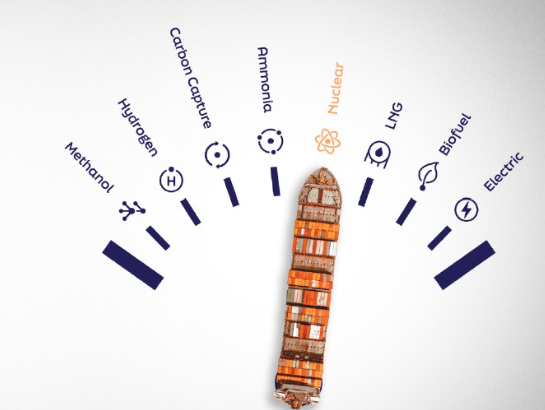
The guidance builds on LR’s “Fuel for Thought: Nuclear research programme” and was developed in collaboration with Global Nuclear Security Partners (GNSP) and marine insurer NorthStandard. It details steps for project teams to integrate nuclear power—including small modular reactors (SMRs)—into maritime assets, highlighting key requirements for regulatory compliance, operational safety, technical design, and financial planning.
LR emphasized that, in the absence of an international regulatory framework, the guidance examines the roles of organizations such as the International Maritime Organization (IMO) and the International Atomic Energy Agency (IAEA), stressing the importance of harmonizing maritime and nuclear standards. The document covers safety classifications, environmental impact assessments, structural integrity evaluations, and the development of a nuclear safety case. Security considerations are also addressed, focusing on physical and cyber protection measures and insider threat mitigation.
Operational and financial aspects are part of the guidance, including personnel qualification inspections, emergency response planning, and quality assurance throughout a project’s lifecycle. It also discusses insurance and reinsurance challenges, emphasizing the need for a predictable liability framework to support commercial adoption.
Mark Tipping, LR’s Global Power to X Director, said: “Nuclear energy has the potential to transform maritime, providing a scalable and zero-carbon energy source that can accelerate the industry’s energy transition. However, its adoption requires clarity, collaboration and trust across regulators, operators, insurers and wider society.”
Nick Tomkinson, Senior Partner at GNSP, added: “Maritime nuclear will only succeed when safety, security and safeguards are considered together from the start. This guidance document helps first movers align maritime and nuclear frameworks, apply goal-based approaches where prescriptive rules are absent, and build the confidence required by regulators, insurers and the public.”
Although global regulatory standards are not yet fully established, nuclear power is gaining attention from companies seeking to achieve climate neutrality. The UK has committed to triple nuclear energy capacity at COP 28, reflecting growing national support for advanced nuclear technologies.
Earlier initiatives include a February 2025 report by LR and NorthStandard with CORE POWER, proposing a policy framework for UK deployment of small nuclear reactors on commercial ships and floating nuclear power plants. In April, LR partnered with Queensland-based Seatransport and Houston-based Deployable Energy to develop nuclear generation solutions for maritime applications, including fitting two to five 1MWe modular reactors on a 73-meter amphibious vessel capable of operating eight to ten years without refueling.
In September 2025, UK and U.S. companies signed a landmark agreement to accelerate the expansion of nuclear power stations in both countries, demonstrating growing international collaboration in maritime and energy sectors.
Overall, LR’s guidance provides a structured approach for safely integrating nuclear power into shipping, supporting the maritime industry’s transition to low-carbon energy while addressing technical, regulatory, and financial considerations.












 京公网安备 11010802046720号