

Wedoany.com Report-Oct. 20, After a 26-day voyage, the first container ship operating on the China-Europe Arctic container express route, the Istanbul Bridge, arrived early Sunday morning at the Port of Gdansk in northern Poland. The vessel began berthing at the Baltic Hub Terminal before 6 a.m., slightly delayed due to sea conditions, and loading and unloading operations began around 7 a.m., according to port authorities.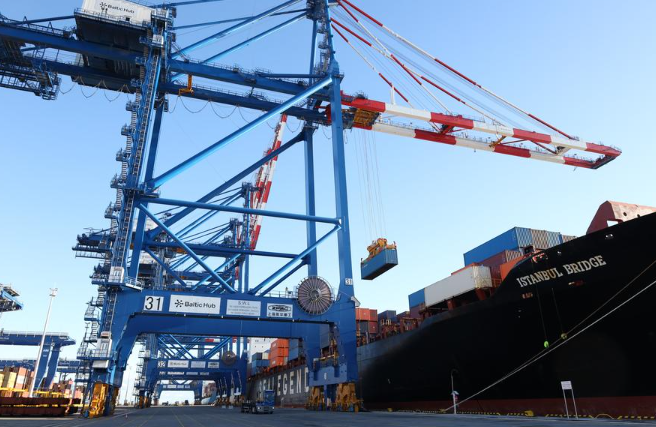
This photo taken on Oct. 19, 2025 shows a container being unloaded from the "Istanbul Bridge," the first vessel on the China-Europe Arctic container express route, at the Port of Gdansk, Poland.
Departing from Ningbo-Zhoushan Port in Zhejiang Province, China, on September 23, the Istanbul Bridge carried about 4,000 twenty-foot equivalent units (TEUs) of cargo. It made port calls in Britain and Germany before reaching Poland. After completing operations in Gdansk, the ship is scheduled to depart for the Netherlands on Sunday night.
The China-Europe Arctic Express Route uses the Arctic’s Northeast Passage to connect directly to Europe, offering a shorter and more efficient alternative to traditional shipping routes. Compared with the 40-day journey through the Suez Canal or the 50-day route around the Cape of Good Hope, the Arctic route significantly reduces travel time. The Istanbul Bridge reached its first European destination, Felixstowe in Britain, in just 20 days—faster than the China-Europe freight train, which typically takes around 25 days.
Li Xiaobin, Chief Operating Officer of Sea Legend Line Limited, the route’s operator, highlighted the advantages of Arctic navigation: “Sea and temperature conditions along the route are ideal for transporting temperature-sensitive and time-critical goods. The low temperatures help preserve certain high-tech components.” Li added that the successful completion of this voyage demonstrates the commercial feasibility of the route and its potential to enhance logistical efficiency between China and Europe.
Sea Legend Line plans to establish regular summer voyages on the Arctic route by 2026, leveraging favorable seasonal conditions for navigation. During the winter months, when parts of the route are non-navigable, the company intends to expand its express service network into Eastern Europe to maintain consistent logistics operations and service continuity.
The Arctic Express Route represents a major milestone in the evolution of maritime trade between Asia and Europe. By cutting travel distance and transit time, it not only enhances trade efficiency but also supports global efforts to diversify shipping corridors and improve supply chain resilience.
At the Port of Gdansk, port authorities emphasized the strategic importance of this route for northern Europe’s logistics network. The Istanbul Bridge’s successful arrival marks a significant step toward integrating Arctic sea transport into regular global trade operations.
The ship’s journey reflects growing international interest in the commercial potential of Arctic shipping lanes, as advances in vessel technology and route planning make these passages increasingly viable during ice-free seasons. With plans for regular service beginning in 2026, the China-Europe Arctic container express route is expected to play a growing role in strengthening economic connectivity and facilitating faster, more sustainable trade between Asia and Europe.












 京公网安备 11010802046720号